
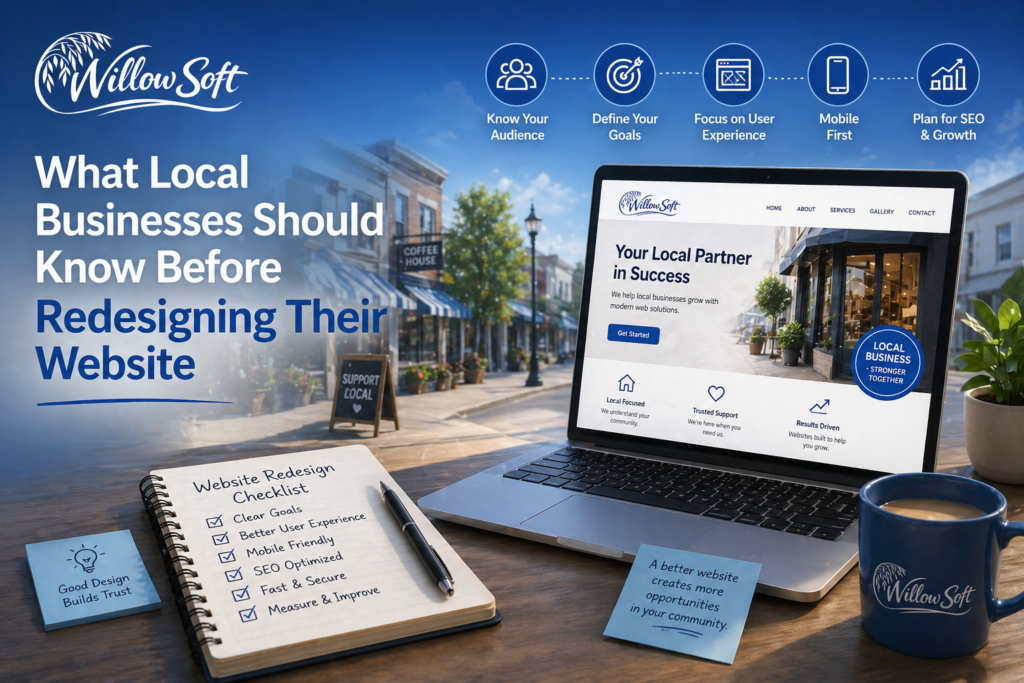
Introduction: A Website Redesign Should Solve Business Problems
For many local businesses, a website redesign begins with a simple thought: the current site looks old. That may be true, but appearance is only one part of the issue. A redesign should not be treated as a cosmetic project only. It should solve real business problems, such as unclear service information, weak mobile experience, poor lead generation, outdated content, difficult editing, or a lack of trust signals.
A better website should help customers understand the business faster and take action with more confidence. Before redesigning, local businesses should look carefully at what the current site does well, what it fails to explain, and what customers need before they call, request a quote, schedule a service, or visit the location.
Start With the Purpose of the Website
Before choosing colors, layouts, templates, or a new platform, a business should define what the website is supposed to do. For some local businesses, the main goal is to generate quote requests. For others, it is to support phone calls, appointment booking, store visits, project inquiries, or service area visibility.
A redesign becomes more focused when the goal is clear. A surveying company may need stronger service pages and better quote forms. A contractor may need project examples and testimonials. A local consultant may need case studies and a consultation request process. A shop or clinic may need location details, hours, directions, and easy contact options.
Without a clear purpose, a redesign can become a visual refresh that looks better but does not perform better.
Review What Is Already Working
An existing website may be outdated, but that does not mean everything on it should be removed. Some pages may already bring visitors from search. Some service descriptions may still be useful. Some photos, testimonials, or location information may still help customers make decisions.
Before redesigning, local businesses should review the current site carefully. The goal is to identify what should be kept, improved, rewritten, combined, or removed. A redesign that ignores existing strengths can accidentally weaken the site.
This is especially important for businesses that have had a website for years. Even if the design looks old, some content may still have value. A smart redesign protects what works while improving what holds the business back.
Understand the Customer Journey
A local business website should be built around the way customers make decisions. Visitors usually arrive with questions. They want to know whether the business provides the service they need, whether it works in their area, whether it seems trustworthy, and how easy it is to get help.
A redesign should make that journey easier. The homepage should orient visitors quickly. Service pages should answer practical questions. Trust signals should appear near decision points. Contact options should be visible. The mobile experience should make it easy to call, request a quote, or find directions.
When a website is designed around the customer journey, it becomes more than a digital brochure. It becomes a tool that helps people move from uncertainty to action.
Improve Service Pages Before Improving Visuals
Many local business websites have weak service pages. They may list services briefly without explaining what each one includes, who needs it, or what happens next. This creates confusion, especially for technical or specialized services.
Before focusing too much on design, a business should strengthen the content and structure of its service pages. A good service page explains the problem the customer is trying to solve, the service provided, the process, the service area, and the next step.
For local service businesses, stronger service pages can also support search visibility. Customers often search for specific services, not just company names. A redesign is a good time to create clearer pages for the services that matter most.
Make Mobile Experience a Priority
A local business website must work well on mobile. Many customers search while they are away from a desk, comparing providers, checking hours, looking for directions, or trying to contact a business quickly.
If the mobile version is hard to use, the redesign is not complete. Text should be readable, buttons should be easy to tap, forms should be simple, and key information should appear in a logical order. Contact information should not be hidden, and pages should not require unnecessary effort to navigate.
A mobile-friendly website is not just about design quality. It affects whether visitors stay, understand the business, and take action.
Make Contact Easy
A redesign should make it easier for customers to reach the business. This sounds obvious, but many websites still make contact more difficult than it should be. The phone number may be hard to find, forms may be too long, buttons may be vague, or the contact page may not explain what happens after submission.
Local businesses should use clear action language. Instead of generic buttons like “Submit” or “Learn More,” the site can use more specific calls to action such as “Request a Quote,” “Schedule Service,” “Book a Consultation,” or “Contact Our Team.”
The contact page should also support confidence. It can include response expectations, service area information, business hours, location details, and a short explanation of what information the customer should provide.
Build Trust Into the Redesign
Trust is one of the most important reasons people choose a local business. A redesign should make trust easier to see and feel.
This can include testimonials, project examples, photos of real work, certifications, licenses, years of experience, local service areas, professional associations, team information, and clear explanations of the process. These elements should not be hidden at the bottom of the site or placed only on one separate page.
Trust signals are strongest when they appear near the places where visitors are making decisions. A testimonial on a service page can support the service description. A project example near a quote request can reduce hesitation. A clear process section can make the business feel more professional and reliable.
Choose the Right Platform for Future Updates
A redesign is not only about how the website looks on launch day. It is also about how easy the website will be to manage afterward. If a business cannot update its own service information, photos, forms, testimonials, or location details, the site may become outdated again.
Local businesses should choose a platform that fits their long-term needs. Some may need a flexible platform like Wix to support pages, forms, SEO settings, mobile design, blog content, and ongoing updates. Others may need a simpler website with fewer moving parts. The right platform depends on what the business needs to maintain, publish, and improve over time.
A website should not trap a business in a system that is difficult to edit. The redesign should make future updates easier, not harder.
Read also: Choosing the Right Platform to Move Your Website To
If your current website was built on Weebly or another older website builder, a redesign may also be the right moment to compare alternative platforms. Some businesses need more design freedom, better mobile control, stronger SEO options, easier content management, or more room to grow.
For a broader look at possible options, read this guide from Weebly-to-Wix.com: Top Weebly alternatives: best platforms to move your website to. It can help business owners think through whether Wix or another platform is a better fit before starting the redesign process.
Avoid Redesigning Without a Content Plan
A common mistake is treating content as something to add after the design is finished. For local businesses, content should guide the design. Service descriptions, testimonials, FAQs, project examples, location information, and contact details all influence how pages should be structured.
A redesign without a content plan often leads to attractive pages that feel empty, vague, or hard to use. Before building the new site, the business should decide what pages are needed, what information each page should contain, and what action each page should encourage.
Design makes the website look better, but content makes it useful.
Think About Local Search Visibility
Local businesses often depend on customers who search for services in a specific area. A redesign should support that behavior. The website should make service areas clear, use specific service language, and provide useful content that matches what customers are searching for.
This does not mean stuffing pages with keywords. It means creating clear, helpful pages around real services and real locations. A business that serves multiple areas may need location-based content. A company with specialized services may need individual service pages.
A redesign should improve how the website communicates with both people and search engines.
Measure Performance After Launch
A website redesign should not end on launch day. After the new site goes live, the business should watch how visitors interact with it. Are more people submitting forms? Are mobile users staying longer? Are visitors reaching service pages? Are quote request buttons being used?
These signals help show whether the redesign is working. They also reveal where the site can continue to improve.
A website should evolve as the business learns more about its customers. The best redesigns create a stronger foundation, but they also make future improvements easier.
Redesign With Strategy, Not Just Style
A local business website redesign should do more than make the site look newer. It should make the business easier to understand, easier to trust, and easier to contact.
Before redesigning, businesses should clarify the website’s purpose, review existing content, improve service pages, prioritize mobile experience, strengthen contact options, build trust signals, and choose a platform that supports future updates.
A successful redesign is not only about design. It is about creating a better business tool. When strategy, content, platform choice, and customer needs work together, a redesigned website can help a local business attract more inquiries and support long-term growth.